
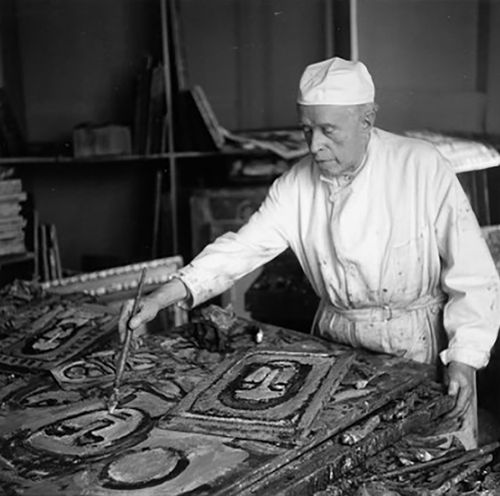
"I saw quite clearly that the 'Clown' was me, was us, nearly all of us.", Georges Rouault
Georges Rouault (May 27, 1871 – February 13, 1958) was a French painter, draftsman, and printmaker, often described as the most important religious painter of the twentieth century and one of the central figures of European Expressionism. Born in Paris during the Commune bombardment, the son of a cabinetmaker, he was apprenticed at fourteen to a stained-glass painter and spent five years restoring medieval glass, including windows at Chartres, before entering the École des Beaux-Arts in 1891. There he became a favourite pupil of the Symbolist painter Gustave Moreau, in a class that also included the young Henri Matisse and Albert Marquet, and after Moreau's death in 1898 he was appointed the first curator of the Musée Gustave Moreau in Paris.
His mature painting fused the heavy black contour and glowing color of medieval stained glass with a deeply Catholic moral vision, taking as its subjects Christ and the New Testament, prostitutes, judges, lawyers, and the clowns of the Cirque Médrano. From the 1910s onward he worked at the long graphic project, eventually published in 1948 as the Miserere et Guerre portfolio of fifty-eight plates, that the dealer Ambroise Vollard had commissioned as one of the great print cycles of twentieth-century European art. His paintings and prints are held in the Centre Pompidou, the Museum of Modern Art, the Tate, the Metropolitan Museum of Art, the Vatican Museums, and essentially every other major collection of twentieth-century European art.